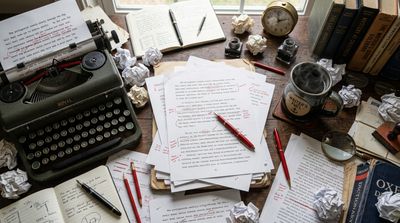
In the old day when a story was written on paper or with a typewriter, things like "first draft," "second draft," and "third draft," made a lot of sense because you dealt with the manuscript as a whole, a pass at a time. There was a tangible artifact representing each draft.
Today? Not so much.
Since word processors came along it's really hard to tell what "draft" you are on.
I'm not saying a writer doesn't have a process, we all do, and that process doesn't have phases or cycles, they do, but the clean metric of which "draft" you're on or how many "drafts" an manuscript goes through doesn't mean anything anymore despite the term still being in use (and I just used it).
Here's a bit about my process for a novel (short stories have a slightly different path):
-
Write. I write the story from start to finish (more or less). This involves a lot of "cycling," where I at least read the previous day's words and edit before typing new words. It also includes popping back earlier in the manuscript to check or alter things.
-
Simmer. Here's where I let my subconscious chew on the story as a whole, and when thoughts pop up (most often while in the shower or walking), I'll go back and make changes. Add, delete, clarify, stuff like that.
-
Wait/Marinate. To gain distance from the story, it usually sits for a while. I've often been very bad about this, with manuscripts waiting three years or more for me to get back to them. Ideally this would be four to eight weeks.
-
Finish. This is the process of completing the manuscript. I won't go into details (I want to leave a little mystery), but suffice it say there are several passes here including professional copy editing. The goal is to get the mistakes out, the things that were not intentional. (Note: I did not say make the grammar perfect, this is fiction after all, and folks don't speak in perfect grammar, and if they do, I suggest you stay away from them, cause there just might something wrong with them.)
In my mind, the first two phases ("Write" and "Simmer") are where the fun is and where the creative juice is (this is why it makes no sense to involve AI in this part). Finishing feels more like actual work (which could explain why it can take me a while), but has its fun parts.
That's just my process, but can you see how "first draft," "second draft," etc. doesn't even apply to it? Some parts of the story I'll go over five or six times, other parts many more times than that.
At this point, I will say that I "drafted" a novel, as I just did, just don't ask me what draft I'm on. I have no idea.
The above image was created by Gemini. I mention this to tie in with my musings on AI in Creativity._
Leave a Comment