A Boy, a Girl, and a Ghost
SATURDAY, JUNE 11, 1977
I’m starting to be able to see him… the ghost, that is. Not
just a flash of light out of the corner of my eye, like I see all over the
graveyard, but square on. He’s very skinny with sunken-in cheeks and a
mustache. His mouth moves, and his brown eyes look so earnest. He’s trying to
tell me something, something important. But I can’t hear him.
It all started a few weeks ago. I’ve been having a good
year, probably my best year. Chemo ended last November, the leukemia is
officially in remission, and I even got to attend a lot of tenth grade.
It was a Saturday night, school had just let out, and Mom
had made meatloaf for dinner, with mashed potatoes and gravy. Dad went on and
on about the Shakespeare festival and the replica of the Old Globe Theatre that
had just been completed. He was so excited, and to the tell the truth, so was
I. He had been taking me to plays since I was old enough to sit still for two
hours (well, three, let’s be honest Shakespeare’s plays tend to be long).
“The Globe Theatre, here in Cedar City, Utah,” he chuckles,
playing with what was left of his mashed potatoes with his fork, mounding them
up higher and higher. “Do you know what that means, Aaron?” He doesn’t wait for
me to answer, his grey eyes sparkling behind his glasses. “It means our little
Cedar is going to be something. A lot more people will come to the festival. We’ll
be on the map.”
Cedar City is in Southern Utah on Interstate 15, an hour
north of St. George and the Arizona border, and a long ways from Las Vegas or
Salt Lake City or anything at all resembling a real city.
Cedar City was founded in the mid-1800s as an iron mining
settlement. It’s a small town with about 10,000 people and wouldn’t be much at
all without the university.
“It means,” I offer, “your little bookstore will get busier
selling stuff to those tourists.” His shop is on Main Street just a couple
blocks from Southern Utah University and in our little downtown area. He
teaches English at the university and runs Cedar Books and Such.
“Yes it will, son. Yes it will.” He gets this distant look
in his eyes as if he is seeing all those people entering the shop, asking for
the odd book, going away happily clutching their purchases.
I catch my mom’s eye, she is leaning against the kitchen
counter with her arms crossed, smiling. It is an entirely mundane conversation
about normal things, having nothing to do with Cancer (in this house “cancer”
has a capital “C” like it’s a living thing and deserves to be referred to with
a proper noun).
“Good day?” Mom asks me later as I am heading up to bed. Her
pink lipstick is slightly smudged, her blue eyes drilling into me. She had
started this ritual when I was eleven, when the leukemia first hit. I think it’s
her way of acknowledging the tenuous nature of my existence and being a nurse,
she understands it better than most.
“Yeah, good day. You know how I love meatloaf.” I gave her a
big smile which I saw echoed on her face. People have always told me I have her
eyes and her smile, which I take as a compliment. Because when my mom smiles,
you can’t help but feel some happiness.
“Good. Get some rest, church in the morning.”
I want to protest, but don’t bother. It would do no good. My
mom always wants me to go to church and I never want to go. It’s a thing.
I trot up the steps into my room and flop onto the bed. I
crack open Richard Bach’s Illusions. I am fascinated by the book’s view
of our world as not real, as an illusion. Not a stretch, I know. If this world
is illusion, then my Cancer is too. But the book doesn’t hold my interest, I feel
a restlessness I can’t explain.
I shut the light off and pull the sheet up; my window is
open, but my room tends to stay hot in the summer. I stare at the glow-in-the dark
stars on my ceiling. I’m up in the second floor with my ceiling the sloping
roof of the house. I’ve got a dormer and a window, but it’s mostly roof. When I
was eight, my dad put the stars up after much asking and whining. I know I’m a
bit old for them, but I still really like them.
When I finally fall asleep, I have this dream of when I was
a little boy. I don’t remember who had died, but my mother took me to the Cedar
City Cemetery when I was very young, maybe four years old.
The cemetery sits on the north edge of town and is an oasis
of tall trees and grass in the desert. It is surrounded by a wall made of
reddish sandstone blocks, which is taller than me at that point. I touch the
rough surface as we pass through. I remember liking it, jumping on the grass
with joy, only to receive a tight-lipped frown from my mother. What is not to
like about all this grass with the oddly square pieces of stone placed at
regular intervals. It is a park of some kind. It has to be.
I keep jumping and playing, I can’t help myself. Among the gravestones,
I see the strangest people. There are three of them, and they move so
gracefully between the granite stones, as if they are floating.
One sees me and waves. I wave back. He’s a chubby man and
smiles at me, motioning to his friends to come look. All three of them, the chubby
man, a little girl, and a boy wave at me.
“Mama,” I say. “What is wrong with them? I can see through
them.”
Her mouth moves and she blinks hard, looking carefully over the
headstones where I’m looking. “Aaron,” she says to me, “I don’t see anyone. What
are you talking about?”
“Them,” I say, pointing and then waving back. “There is a
girl my age. Can I go over there and play?” They all look so excited when I
wave to them, I just know they want me to come over.
My mom looks me over for a few moments, her face so serious.
She then takes my hand and leads me away, and never takes me down to the graveyard.
I remember seeing the three of them and their sad faces as they watched us go
from behind that sandstone wall.
I woke up all in a sweat. I had forgotten all about it, and
as I boy I never thought they might be ghosts. Now, I know that is what they
must have been.
I sneak down the stairs dressed, but without my shoes on. I
know which stairs creak, carefully stepping over those. It is almost midnight
and the dream will not leave me alone. I feel compelled to go.
At the front door, I stop and listen carefully, the smell of
meatloaf still hanging in the air. I can hear the tick-tock of the clock in the
living room, the sigh of the breeze outside, and nothing else.
I slowly pull back the dead bolt, freezing as it clicks
home, sure it was loud enough to wake my parents. Nothing.
I ease the door open, the creaking of the hinges making my
heart bang in my chest. I make a mental note to oil them. I ease out the door
and slowly close it, put my shoes on, and walk quickly away from my house.
I want to ride my bike—riding feels more natural to me than
walking—but I don’t want to risk anymore noise. I walk down the deserted
streets of my neighborhood, get on Main Street, a few cars still ambling along,
and head north to the graveyard. It’s cool, in the lower fifties, and I pull my
sweat jacket tight, more scared than cold.
I stand there for a moment on the sidewalk in front of that
low wall, my hand brushing at the rough sandstone. I had been by it a thousand
times and never seen ghosts except for that one time when I was like, four. I
am not sure what I expect. Did I really think the dream was trying to tell me
something?
Guilt plagues me. I’m not really the kind of kid that sneaks
out of his house in the middle of the night. But I’m not exactly normal either.
I have suffered years of illness, doctors, treatments, and overprotective
parents.
I follow the wall until I come to one of the narrow roads
that lead into the cemetery. It’s lined on both side with massive cottonwood
trees, their leaves swaying in the darkness above me, the sound of it
comforting.
I have people here. My friend Charley who died in a car
wreck a couple of years back and my uncle Don.
The thought of my uncle, my mother’s brother, sticks with
me. He was this big burly man who would envelop you in his hugs but had this
kind way about him. He had this lilting southern accent that I loved, one that
my mother seems to have trained herself out of. He was a long-haul truck driver
and died about two years ago. He got the flu and just never got better.
My mom and I came to his grave and placed flowers regularly
the first few months after he died, but she suddenly stopped. Since I’m there,
I decide to pay my respects. I click on my flashlight and walk back into the
graveyard, take my second left, turn right at the fir tree and walk back until
I find his modest granite headstone.
Donald Evan Walters
August 1, 1938 - May 16, 1975
Beloved father and husband
I sit down with a sigh, clicking the flashlight off and
letting the darkness come back. The lights of Main Street aren’t that far, and
I can hear the low hum of the traffic on the highway, but it feels good to just
sit here with just the breeze and headstones for company.
I’m young, turned sixteen last month, but the Cancer has
made me look hard at my own mortality. We all die, right? How smart is it to be
afraid of the most inevitable thing?
I imagine my uncle Don, what is left of him, lying below the
ground. They call them headstones, so I figure the marker is where his head is,
so I lie down on the grass with his headstone at my head, so I am positioned
just like he is.
I stare up through the trees at the star-filled sky and take
a deep breath, letting it slowly escape in a long sigh. I miss my uncle. When I
was a boy, he would play with me so hard, rolling around on the grass with me,
laughing. When I got sick he didn’t treat me differently, he’d still joke with
me, slap me on the back, tickle me. Most folks seemed to be afraid to break me,
but not him.
It’s while I’m lying there that I catch this flash of motion
out of the corner of my eye. It’s not much, nothing I can identify, but I’m
sure I’ve seen something.
I sit up and look around. Nothing. My eyes have adjusted to
the dark and if someone was there I am sure I would have seen them. I slow my
breath, my heart pounding in my ears, and listen. Nothing.
I think about lying down, but I don’t feel so safe anymore.
I’m about to get up and leave when I see it. A flash of white out of the corner
of my eye. I swivel my head to the right, but I don’t see anything.
“What the hell?” I mumble.
I get to my feet and slowly look all around, and there it is
again. Another flash of white that looks vaguely like a person. I look directly
at it and, again, see nothing.
I bite my lip and slowly move my eyes back so they are
facing forward, and there it is. My sense of it is rather vague, like trying to
see something clearly out of your peripheral vision—you can’t. It’s this
whitish human-looking form standing placidly.
I keep my eyes forward and point to it, realizing my hands
are shaking and I am sweating despite the cool air. “Are you real?”
After I speak, what I see changes. It’s not a person
standing still, it’s a person wildly waving their arms. My dream comes crashing
back and I’m convinced it’s a ghost.
I run home as fast as I can.
This is the end of the excerpt.
Part of A Boy, a Girl, and a Ghost: A Novel of… Love, Life, and Family
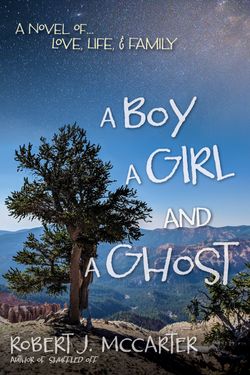
A Boy. Sixteen-year-old Aaron Wade. With his “second strike” with leukemia in remission and his health restored, the summer of 1977 feels like a turning point… until he starts to see a ghost in the Cedar City, Utah graveyard.
A Girl. Seventeen-year-old Helena Monfort. She grew up too early, the tough girl with a bad reputation that just needs a friend.
A Ghost. Lionel Malak. A simple man, he doesn’t understand why someone would murder him, but longs for justice so his spirit can rest.
After Helena escapes a date gone bad, a boy, a girl, and a ghost meet in the Cedar City graveyard under the stars. A chance meeting turns into a friendship, a murder investigation, and an exploration of life, death, friendship, and family you will never forget.
From the creative mind of Robert J. McCarter, author of Shuffled Off, comes a novel of love, life, and family (with a ghost).